Showing posts with label No Dice. Show all posts

Friday, 10 October 2014

Euclidean Geometry of Diffraction

Experiment is now going and getting results. However, frustratingly we are spending most of our time not acquiring the good data but getting the settings correct to collect good data. This is just the way of things, and the reason why it takes 7 days (24hrs) So as I hinted to before we need to find ourselves, the truncation rods (high angle diffraction) and specular ridges (reflectivity) in a 3D reciprocal space.
After trawling around a bit I have found a good paper for example of geometries and I'll show the main examples here.
If you imagine a 3D sample suspended in a vacuum with no external forces then the simple motions of that sample are clear forward-back, left-right and up-down. The complication comes when you consider the freedom to rotate about any axis (figure) and the fact that you must keep the scattering vector S normal to the sample surface in order to conduct the tests we are looking at.
Examples of possible rotations of the sample, while retaining the scattering vector S normal to the sample
 However you may have noticed that there is one other possible rotation possible which amounts to what we call asymmetric case (figure) and the scattering vector no longer normal to the sample surface.
Examples of the required case and off specular due to a rotation
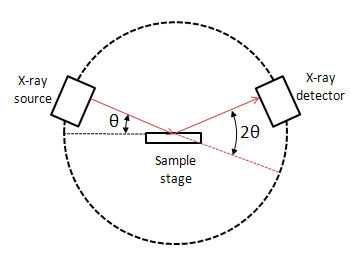
In order to get scattering theoretically your sample is flat the 2omega = 2theta as shown but in reality there will be some offset in omega due to the relative rotation around our forward-backwards axis.
If you have done all this, understanding and accounting for the "flatness" of your sample through a series of complex compound rotations the you are ready to scan through omega-2theta (linked) so that S the scattering vector is always perpendicular to the sample resulting in the intensity readings on the detector that give you information about the sample. "What information you ask?" well I'll get to that next time. For now I'm off to look at L edge absorption.

Thursday, 9 October 2014

Measuring your photons

X-rays are incident on a sample and then they bounce off, because of their coherent incidence it means that some scattered X-rays add together and others cancel out and we call this diffraction. But the key thing it means is that there are not X-rays everywhere only at allowed angles relative to the surface and in the case of single crystals as we have here at Diamond only in particular directions as well.

A simple 1D version of X-ray Diffration


So imagine a sphere around your sample (which is illuminated by your X-rays) and if you were to look around on the surface of that sphere only at distinct spots would you observe any X-rays scattered from the sample. This makes measuring the X-rays an initial mental calculation as to where to look in 3D space where you have control over the x, y, z, rotation around x, rotation around y and rotation around z of the sample and then motion of the detector in polar co-ordinates with a fixed r value centred around your sample.
So far too many compound motions translated into reciprocal space with very distinct peak intensity locations, our very own version of a needle in a haystack.
I'm sure this sounds all nice and complicated I unfortunately could not find a clear diagram, so I will have to make one. Watch this space (after lunch) as a photo of the actual kit is somewhat confusing without being able to look round it.
Photo of the set up

Wednesday, 8 October 2014

Controlling your photons; Flux and Shape

First things first is to select our prefered beam shape and flux using the X-ray optics on the beamline to utilise the X-rays produced by the synchrotron.

The beamline we are using is I07 which specialises in surface and interface diffraction and I'll talk about the detector and sample set up for conducting the experiments later.
So we have three main methods of controlling the beam shape and flux; slits, lenses and attenuators. First things first is to put a camera in the sample position to image the X-ray beam shape and alter the lensing to give a uniform symmetrical gaussian beam profile in both horizontal and vertical directions.  I won't go into too much detail here on the X-ray optics as others have done a far better job elsewhere, such as this presentation from the European Synchrotron Radiation Facility.Then for our uses we then draw in the slits to box off the centre of the beam to give a nice neat square beam footprint. Note there is still some gradient due to the divergence of the beam in the distance between the slits and the samples. That's the shape then we move on to the flux.

Image of the flux detector in the middle of the beam


Replacing the camera with a silicon photodiode detector allows direct and quantitative measurement of the photon flux of the X-rays. This however can only be used for calibration, rather than ion chamber detectors which can be used during the experiment showing relative flux. If you are really interested have a look here for more information on the detectors. This allows us to measure the flux while we change the attenuation using filters, which when it comes to X-rays means big lumps of material. In this case predominantly different thicknesses of aluminium and molybdenum.

So put all these pieces of information together and it means we know what beam profile and what flux of photons are hitting our sample, which is key for our calculations at the end converting observed intensity on the detector into information about the illuminated volume.

What am I doing here? Lab vs Synchrotron

With X-rays you can do a lot of cool physics in terms of investigating crystal structures, elemental analysis, electronic structures and surface topology but why Diamond light source? The simple answer is flux and energy; a far greater flux of photons and greater control over the energy of the incident X-rays.
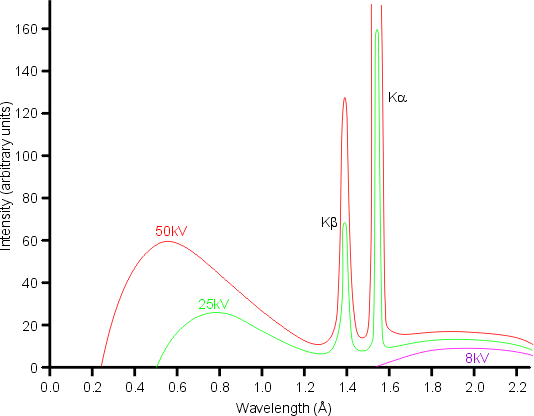
So in a standard lab X-ray experimental set up you generate soft X-rays by accelerating electrons into an anode of chosen material producing two types of X-ray; Bremsstrahlung (German for breaking-radiation) due to the quick deceleration of electrons hitting the anode (the low energy bump) and characteristic X-rays which are at distinct energies associated with the electron energies in the anode material (the spikes labeled Kbeta and Kalpha). Thus most science is done with the characteristic X-rays, by filtering out the Bremsstrahlung X-rays, at the elemental distinct energy with copper tubes being the most used.
As shown in the figure the accelerating voltage of the electrons alters the intensity of X-rays out put of the tube. And the flux of a tube source is of the order 1x10^7 photons per second per mm^2.

Where as with a synchrotron you can select your energy through using magnets to decelerate your electrons emitting the X-rays and using such a large facility leads to fluxes of the order of 5x10^14 photons per second per mm^2.

I need to dash off and sort the sample order for the first experiment so,
I'll be back  . . .

New Science, for me anyway

So I put blogging to one side, like a lot of things, when I started to really focus on my thesis. That was now well over 12 months ago and I sit in front of my keyboard as a Doctor of Philosophy, not that it feels any different.

Anyway so I thought I would throw myself back into blogging with the inspiration of a new experience for me; A synchrotron experiment at Diamond Light Source.

So I'm going to attempt to keep a running commentary with here and twitter on how things go every high (peak) and every low (noise). Here's to high energy photons and successful experiments.

Friday, 15 February 2013

Perception of Science


I often wonder what the world thinks of science and scientists as through out my life I am surround by those within the bubble, as it were. To try and unravel what maybe thought of us by the outside world you have to look at what hits the main stream news and popular culture.
Looking the popular view you get tv shows and definitely Prof Brian Cox with his previously life as a pop star with D:Ream. I see things such as the big bang theory being created showing and increase the scientists stereotype, that is they are socially awkward brainy people that are funny to laugh at as they fail to fit in with the world around us. Brain Cox on the other hand has come to previalance because he is the exact opposite, like Richard Feynman he is easy to talk to and has the ability to explain complex ideas with ease for everyone to understand. Now I am not saying we are all like Brian but think of it this way. We wouldn't have science if scientists where unable to communicate.
This then leads me to labels. Prof Cox labels himself a geek, and you could say that those comic book loving social outcasts in big bang are nerds. But really what is the difference. Can you be a nerd, without being geek or vice versa. Interestingly a team that put together a 'Geek Calender' this year, containing snaps of people like Simon Singh and Ben Goldacre, have at the head of their website 'nerds on the march'. This would suggest that a 'nerd' driven movement has created a calender about geeks.


Admittedly these points lead me further from finding the difference between nerd and geek, but more importantly I see the use of the words changing. No longer are people negatively labelled using these words but more using it as an empowerment.

Friday, 8 February 2013

Radiation: Fact or Science Fiction


Cross Posted from 'Bristol University Science Faculty Blog':
Radiation, radioactive and nuclear are all words that of late have been attributed negative connotations. Not just just thanks to obfuscation of what actually happened to the Reactor in Fukushima, which was down to poor info-structure around the power plant not the fault of the reactor design, all the fail safes worked except the human one of finding a new power source within 8 hours. Yet I think one of the main perception problems with 'radiation' can be phrased as the old adage 'we fear what we do not understand'.
Still I lay my blame with those of the media and science fiction scaremongering. Now this may sound like it is starting to turn into a rant, but if I too just state feelings over facts we will not get anywhere. Thus, from now on I shall leave the opinions you and just present the facts.
650,000 deaths a year, across the globe, are attributed to normal levels of background radiation. The lowest dose, in a short period of time, to cause physical effects like radiation sickness; 25 Rem = 0.25 sieverts. The average a normal person, like you, will in counter in one day is 1x10⁻³Rem = 1x10⁻⁵ sieverts. Tiny, tiny amounts. Interestingly, many places in Cornwall have a higher level of radiation than is allowed in UK schools. Now you maybe thinking of cancelling that trip to Cornwall, but I urge you not to be perturbed the point I am trying to make is that even those who are writing the safety guidelines are overly scared. I am not suggesting you take a blasé approach to radioactive materials, just know the facts. The last thing I am going to leave you with is from a good graphical representation of radiation levels, my favourite bit to point out is that you get more from a banana than from living within 50 miles from a nuclear power plant for a year.

So now to you, go and make your own mind up about 'Radiation: Fact or Science Fiction'. Any response to which is greatly encouraged.

Friday, 1 February 2013

Nano-polycrysatlline materials, what? Why?


Nano-polycrystalline materials: what are they, why are they useful and most importantly, why should we care? For one, they provide a fascinating insight into current science, which will be discussed later. First, “what”, as how can you understand the usefulness of something until you know what it is? For instance, how useful is a latundan? Well unless you are hungry, not very, as it is a Filipino banana. A quick insight: nano-polycrystalline iron-nickel alloy is approximately 400 percent stronger than conventional iron-nickel alloy. Starting to see the potential?
Looking at the etymology of the word reveals what it means. “Nano” refers to the scale (1x10⁻⁹), “poly” means many and “crystalline” means a crystal structure. Thus, we have a material made up of many nano-sized crystals, in this case anything with crystals less than 100 nanometres in diameter. To give a sense of the scale, 1 Billiard (a thousand billions) of them fit in a pint glass. To explain what a crystal is, think back to what is first taught about metals in school, which is, that all the atoms are tightly packed in every direction, for instance imagine packing snooker balls into a cube. This creates a very ordered set of atoms referred to as a “crystal lattice”. In these nano-polycrystalline materials we have nano-sized pockets of this order and the bits around them that hold them together are random. In terms of an analogy, envisage a bowl of sugar cubes that have gotten wet. What is meant by this is there are lots of lumps of sugar that have just started to dissolve around the edges making them all stick together, so each cube is still visible but now they make up one whole.
So why? These materials are a representation of nature, with a few tweaks by human hand, producing remarkable results. Their strength makes them harder than steel; it shows that the actual structure of a material, at an atom by atom scale, is just as important as the composition. So, all manner of things can be created from nano-polycrystalline materials using their beneficial properties to produce something above and beyond that of normal materials.
Now, to the point of what this means for science. The creation of these materials highlights the movement of material development, from the old fashioned system of “let’s add more stuff and see if it makes the material better or worse”, to the creation of materials by selecting the favoured attributes through knowledge of in-depth truths about the physics and chemistry used.
This is a crucial turning point, not just for materials but as a trend in science in general. The move from bumbling explorer, “what happens if I do this?” to the scientist who deliberately decides to do things in order to create a preferred outcome, therefore showing a maturity of thought. Think of it like the stage where humanity instead of finding caves to live in, are building their own ‘caves’ in more preferable spots. So, creating houses as shelter where they want rather than just finding it. Admittedly one cannot come until after the other, yet it is an important step to take.
There are still drawbacks from doing science this way; first to jump to mind unfortunately is that of faked results. There have already been many high profile cases, such as the ‘human cloning’ by South Korean Hwang. Showing when you go looking for something, there is a strong urge to ‘find’ it even if the evidence is to the contrary. However, this is not a question of scientific method more of the ethics and decency of the scientist. Another negative view could be that we will not create anything new, with the thought that we are only doing things we know, yet nano-polycrystalline materials are proof against that. These materials were created due to an observation that materials with smaller crystals are harder than those with big crystals. Further investigation created ever smaller grains leading us to nano-polycrystalline, a previously unknown structure. This is an example of scientists taking previous results as sign posts to find new and better things. Unfortunately in this case we cannot do this forever as if you continue to attempt to create even smaller crystals you end up with a material that has no structure, so is hard but incredibly brittle like glass.
So, what impact does this have on life? Well none, yet. This is one of those areas of research that never makes the headlines, just makes the future. You will, probably, never notice the introduction of nano-polycrystalline materials into the world around you. However, more importantly they throw the change in scientific thinking into stark contrast, no longer are we stumbling along reaping the benefit of accident but now making tools to build our own future.
(A piece written for telegraph writing competition 2011)